
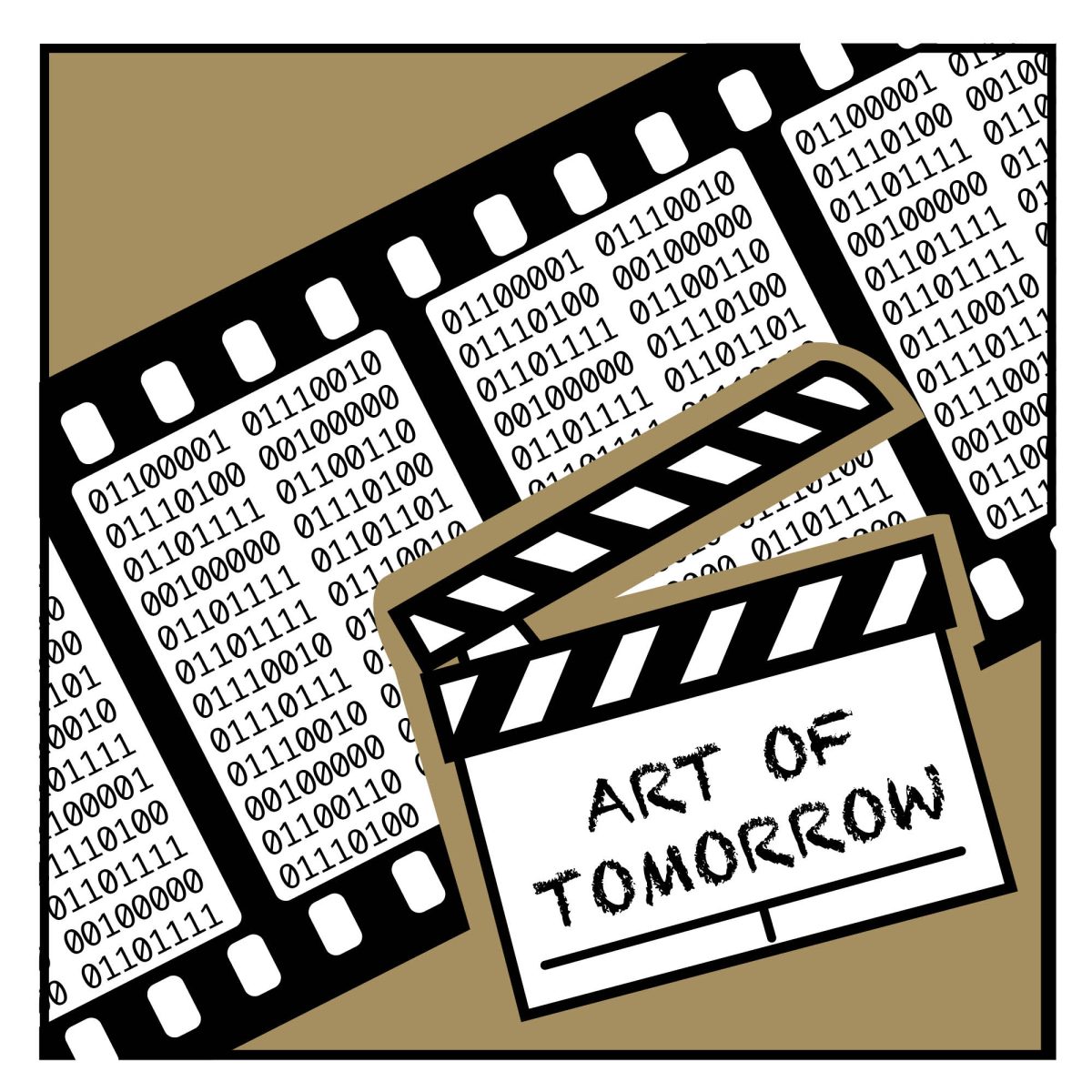
In 30 years you will be getting off of work, heading to the theater with a friend to see the latest movie you’ve been excited for all week. The trailers play, the movie starts — all AI, from actors to story to footage. You wonder: why does a robot get to create art as you toil away, stuck at a desk?
Many people believe AI is the future, implementing it into any website, industry and crevice they can find. Recently, their target has been the film industry.
On Feb. 17, Igor Alferov was announced the winner of the Frame Forward AI Animated Film Festival, a global competition to uncover and spotlight the new generation of “AI-empowered filmmakers.” Alferov’s short film, Thanksgiving Day, has been awarded a highlight in top movie theaters across the U.S thanks to the coordinators’ connections.
The short film features a platypus and bear traversing the galaxy in their run-down spaceship, created with Gemini 3.1 and Nano Banana Pro.
Even watching with the lowest of expectations, I was gravely disappointed.
Screenvision Media, who co-organized the festival with Modern Uprising Studios, is responsible for the 20-minute pre-show trailers and advertisements you see in the theaters, which will now feature Alferov’s short film in select theaters for two-weeks. This is not the first time this has happened, as the winner of the 2025 film festival was presented in 10 select IMAX theaters in August 2025. This time, the reach is larger, including Classic Cinemas, AMC, and TCL Chinese Theaters. However, AMC has informed Screenvision they will not be participating.
As backlash erupted at the news, Joel Roodman, the president of Modern Uprising Studios has come to the defense of the short film and AI usage in media.
“Thanksgiving Day is a masterclass in original storytelling…proving that bold imagination with the tools of AI complements the future of animated filmmaking,” he said.
This has not been the only backlash involving AI, which has already weaseled its way into the filmmaking process.
Seedance 2.0 by Bytedance is a generative video model that has garnered the wrath of Netflix, Disney, Paramount and Warner Brothers for stealing their intellectual property to create short videos with popular characters.
Netflix has sent a letter promising immediate litigation for copyright infringement if they don’t remove their property and establish guardrails for the future.
“Netflix will not stand by and watch Bytedance treat our valued IP as free, public domain clip-art,” Mindy LeMoine, the director of litigation, said.
Unfortunately, this ire directed at Bytedance does not come from a distaste for AI. In fact, Disney reached an agreement with OpenAi in December to allow Sora to generate videos with access to over 200 Disney, Marvel, Pixar and Star Wars characters starting this year. Also part of this agreement, Disney will now use OpenAi to build new products, tools, and experiences for Disney, deploying the use of ChatGPT for its employees.
Disney is excited for this partnership as it is “giving [fans] richer and more personal ways to connect with the Disney characters and stories they love,” and allowing “new ways to create and share great stories with the world,” CEO of Walt Disney Company Robert Igar said.
Expansive companies like Disney and Netflix are by far the first to this generative apparatus. Individuals and corporations have been gradually assimilating AI into operations and techniques.
Lawrence Jordan, a willing passenger for technological advancements in film for decades, is welcoming AI tools with open arms. Working his way up from assistant editor, supporting famous film editors like Dede Allen and Richard Marx on films such as Bonnie and Clyde and The Godfather, has created a website teaching people how to utilize this new technology for AI filmmaking. His website, Aiography, offers live workshops, breakdowns of new AI tools and what to use for writing or researching, and guest experts.
“I’ve been the first to every major technological shift in my industry,” Jordan said in a video promoting his services. “Anologue to digital. Film to Avid. Desktop to Web. And now traditional filmmaking to AI.” He doesn’t view the new technology as inhibiting film, but enhancing it.
With Aiography and hundreds more websites and implementations of AI, public opinion splits on whether AI is another purported tool of the future — one that will be met at first with trepidation then become an integral part of society — or a plague. Will it make creation easier or will it completely usurp the process?
Yes, technology in the past has been reluctantly accepted, but AI is not just an innocent tool. It actively robs artists and creators of their work to meld together a product that aligns with the prompt. Netflix and Disney are outraged when companies like Bytedance allow users to create generative media with their characters, but are more than willing to accept the new technology if they profit.
It is prominently known that the integration of AI and technology as a whole is purely about money. It is easy, cost effective and quick, and that’s all that matters to companies.
They completely miss the point and meaning of art, only viewing it as a product, something to be sold. Art is a story — one that captures passion and humanity. When it stops being created by humans, it loses that vital, indescribable spark that appeals to our emotions and makes it mean something.
Brandon Sanderson, a renowned author, recently gave a speech about AI media that speaks to the heart of the issue. “The most important thing to understand is that the process of creating art makes art of you. That’s the great thing about art — we define it, and we give it meaning,” he said.
Art is significant because we give it significance, imbuing our own stories and feelings between brushstrokes and plot points in films.
Sanderson also gives hope for the future.
“The machines can spit out manuscript after manuscript after manuscript. They can pile them to the heavens itself,” he said, “but all we have to do is say ‘no.’ If we do, they lose.”
Art is not a monopoly. It can not be detained or repressed. It is a proof of life that can not be redefined as anything less.
So please, follow your passions and create messy, chaotic art with untrained hands. Start a novel that you’ll never finish, sketch out a piece you’ll never paint, build something you’ll never show to the world. Just create, and enjoy the process. And finally, do not support companies that give something so innately human to the thralls of machines.